REVIEW · GDANSK
Guided Sightseeing Kayak Tour at Gdansk
Book on Viator →Operated by Around Gdansk | Kayak Tours & Adventures · Bookable on Viator
Gdansk from the water feels different. On this guided kayak tour, you’ll paddle the Motława and canals while landmarks like The Crane come at you from a new angle. It’s a small-group outing built around navigation, safety, and practical stories about how Gdańsk grew up with water.
I like the way the guide takes care of the route, so you’re not stuck figuring out what comes next. I also love the shipyard and harbor stops, where you get to see real industry up close and watch ferries and big vessels in motion. One real consideration: you need to be able to swim, since this is an on-water activity.
In This Review
- Key highlights worth planning around
- From Dokowa 1 to your first paddle stroke
- Why the Motława route is the point of Gdańsk
- The Crane stop: medieval engineering at eye level
- SS Sołdek and the working waterfront feel
- Gdansk Remontowa Shipyard: see ships in repair mode
- Granary Island and Olowianka Island: canals that feel local
- Main City views from canals: how not to miss the best angles
- How hard is the paddle, really?
- Price and value: what $48.85 buys you in Gdańsk
- Small rules that keep the water fun
- Should you book this kayaking tour of Gdańsk?
- FAQ
- FAQ
- How long is the guided kayaking tour in Gdańsk?
- What language is the tour guide?
- Where does the tour start?
- Do I need to know how to swim?
- What is the weight limit?
- Are double kayaks available for couples?
- How big is the group?
- What happens if the weather is poor?
- Can I bring alcohol or smoke during the tour?
Key highlights worth planning around
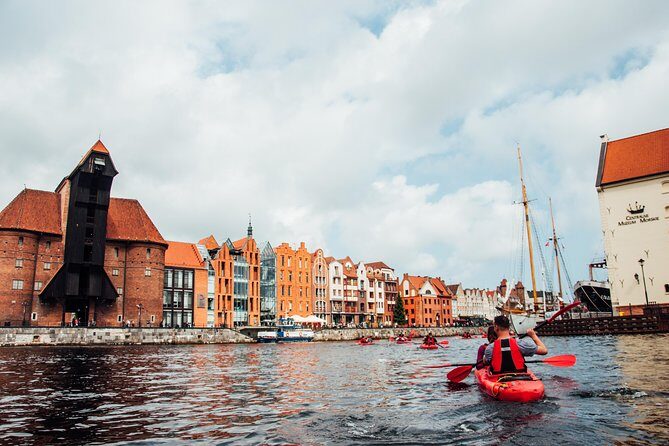
- The Crane on the skyline’s edge: Medieval hoisting tech, told right where it belongs.
- Working shipyard time: Paddle past repair and construction activity, not museum props.
- English guide with steady pacing: Clear instructions and a route designed for people of many levels.
- Double kayaks for couples: A natural fit if you want to share the paddling experience.
- Canal access regular boats miss: You’ll see parts of the Main City that ferries don’t reach.
- Flat-water vibes on the right day: Reviews mention calm water and a not-too-strenuous feel.
From Dokowa 1 to your first paddle stroke
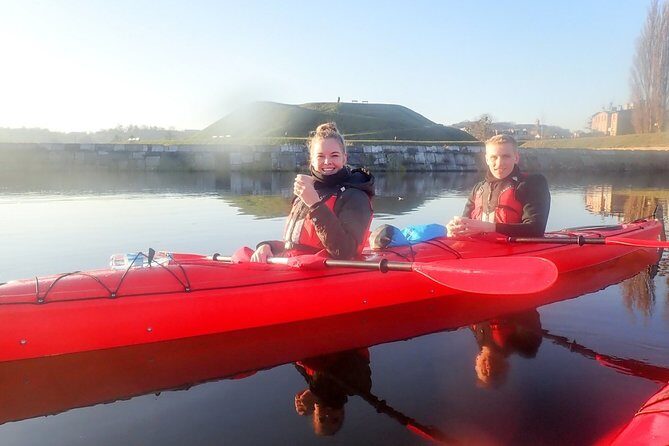
The tour meets at Dokowa 1, Gdańsk (by the water). It’s near public transportation, and one reviewer noted it’s about a 20-minute walk from the historic center and Green Gate, which can work if you’re making a half-day of it.
Plan to arrive early. The operator runs a mandatory safety briefing before you hit the water, and late arrivals won’t be admitted. For most people, that’s a good thing: it means you get clear instruction, the group moves together, and the whole trip stays smooth.
You’ll be on a guided route with a maximum of 20 people. That matters in practice. Smaller groups tend to mean more help when you’re getting used to paddling, especially if you’ve never kayaked before.
Also: this is an English-offered tour, and you’ll need basic English understanding. If you’re the type who likes to ask questions, this setup is a plus—guides are clearly there to explain what you’re seeing, not just lead you around.
Other kayak tours in Gdansk
Why the Motława route is the point of Gdańsk
Gdansk’s shape is tied to waterways. The tour’s route focuses on that reality: the city sits where sea and river routes intersect, fed by systems like the Vistula and connected through rivers such as Radunia and Motława. From land, Gdańsk can look like a classic old-town postcard. From the water, the city’s logic clicks.
Expect paddling through river sections and canals that give you a slower, closer pace than you get from buses, walking tours, or even boat rides. The itinerary is built to show how the Main City connects to ports and working zones—so you don’t just learn names of buildings, you understand why they mattered.
And you’ll get that freedom that only comes with kayaking: you can turn your head and spot details from the waterline. The route is also designed so you don’t feel like you’re “lost” out there; navigation is handled for you.
The Crane stop: medieval engineering at eye level
The first major landmark is The Crane, one of Gdansk’s best-known skyline symbols. This isn’t just a pretty structure to point at—it’s tied to the city’s trading era.
The crane was built in the mid-15th century as part of a shoreline gate complex with two towers. It wasn’t for decoration. It helped install and remove ship masts and load and unload heavy cargo at the quay. The really impressive detail is the lifting ability: up to 2000 kg, making it the largest medieval crane in Europe.
When you see it from a kayak, it feels like you’re watching a working city from the same angle it once served. The guide’s job here is to translate the big story into something you can picture, and the setup makes that easier.
One practical note: it’s a famous symbol, so you’ll likely notice plenty of photos online. But on the water, you also get the sense of scale—how tall and substantial it looks when you’re close enough to see the structure’s edges instead of just silhouettes.
SS Sołdek and the working waterfront feel
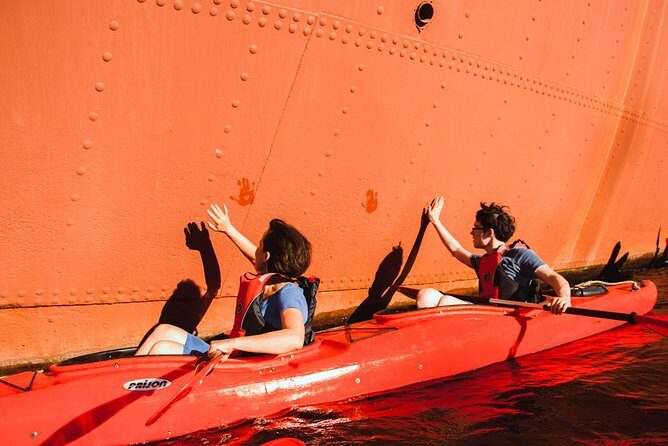
Next up is SS Sołdek, described as a Polish coal and ore freighter. This stop gives you a different kind of lesson than monuments do. Instead of only talking about merchant buildings, the tour highlights the real materials and industries that drove the port economy.
From the water, you also get that working waterfront feeling—less staged, more functional. Even if you’re not a ship-history person, the change of topic keeps the tour from feeling like a lecture that never ends.
The best part of this kind of stop is how it ties together the earlier crane story: trade needs ships, ships need cargo handling, and cargo handling needs infrastructure. It’s an easy chain to follow when you can see the waterfront while you learn it.
Gdansk Remontowa Shipyard: see ships in repair mode
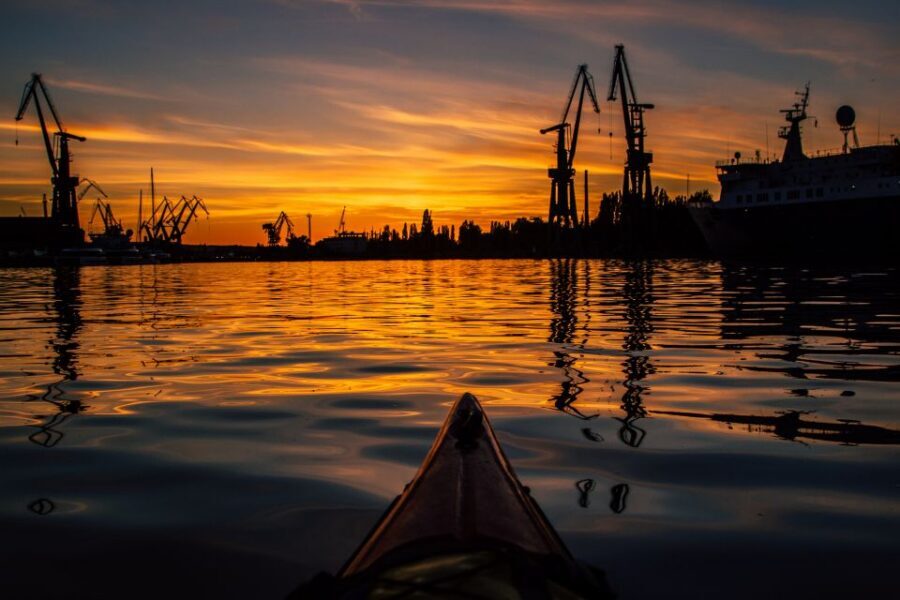
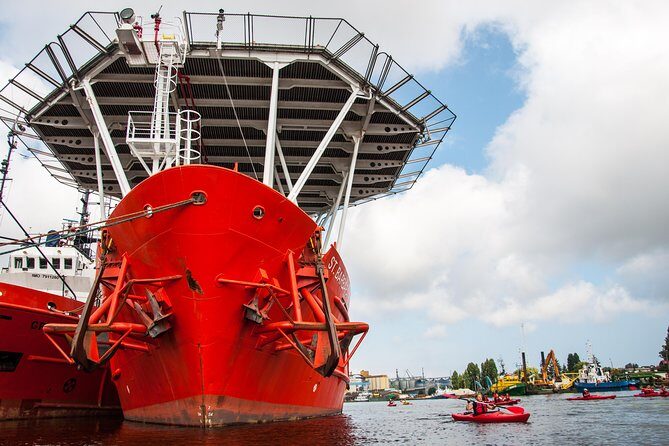
Then comes a standout for many people: Gdansk Remontowa Shipyard. This is still a working yard. That means you’re not just admiring ships behind fences—you’re paddling where people are repairing and constructing vessels.
A review specifically called out seeing men working on ferries, and that’s the kind of detail that makes the tour feel real. You’ll get to observe ships of different sizes and stages of work, which is hard to replicate from a walking route.
If you like infrastructure, machinery, or just the vibe of industry, this is where the tour earns its spot on your itinerary. You’re also getting variety. A city sightseeing day can get repetitive—old streets, more old streets. Here you’re on the water watching the engine room of the city.
And because kayaking keeps you close and slow, you can take in the yard’s layout without rushing.
Other guided tours in Gdansk
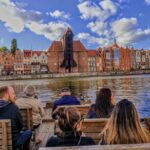

Granary Island and Olowianka Island: canals that feel local
The route loops through the Motława River around two islands of Gdańsk, including Granary Island and Ołowianka Island. These areas are part of what makes Gdańsk distinctive: the city isn’t only coastal. It’s also river-connected in a way that shaped everyday life, something the tour emphasizes with the idea that water was central to how the city functioned.
The islands add visual texture. You’re not stuck staring at one stretch of shoreline for the whole trip. Instead, you get to watch how the waterways open up and how built spaces sit right along the banks.
This is also where the “different perspective” promise becomes real. Paddling canals gives you angles that ferries can’t always access. You’ll notice details that feel too small to catch on foot.
Main City views from canals: how not to miss the best angles
One of the big reasons people book this kind of kayaking tour is the angle. From the water, the Main City looks more connected to its harbor than you might assume on land.
The canal paddling means you can see city sections that are basically hidden from typical sightseeing routes. Even if you’ve already walked the historic center, you’ll likely spot a different relationship between buildings, bridges, and waterfront edges.
The guide also helps you connect the dots: what you’re seeing, what it used to mean, and why the waterfront still matters. That’s why the route feels less like a random paddle and more like a guided story you’re actively inside.
If your travel style is “show me how people lived and worked,” this works especially well. The tour doesn’t only chase landmarks—it links them to water-based city life.
How hard is the paddle, really?
This is about 2.5 hours total. Reviews describe it as not too strenuous, including mention of people in their late 50s doing fine.
That said, I’d treat kayaking as light exercise, not a flat walk. You’ll be doing repeated arm work for a while. If you’re worried, focus on a mindset shift: you’re not trying to win a race. You’re trying to keep steady strokes and enjoy the route.
Also, the tour includes the basics so first-timers aren’t left guessing. People who had never kayaked before and were anxious reported that the instructions helped them get comfortable during the trip.
Two non-negotiables:
- You must be able to swim.
- You need to be comfortable following safety directions promptly.
Those two points shape the experience as much as weather does.
Price and value: what $48.85 buys you in Gdańsk
At $48.85 per person for roughly 2 hours 30 minutes, the price is in the “activity money” zone, not the “just a ticket” zone. So what makes it feel worth it?
First, you’re not kayaking on your own. You’re paying for guided navigation, a safety briefing, and on-the-water interpretation as you move between key sites. That’s a big difference versus renting gear and figuring out your own route.
Second, the group size is kept small (max 20). Reviews repeatedly praise guides for keeping people safe and for sharing information that makes the sights click. You’re paying for that human element, and the feedback suggests it’s part of the deal.
Third, the sights are varied in a smart way: medieval infrastructure (The Crane), industrial history (SS Sołdek), live shipyard activity, and calm canal/island scenery. That combination is hard to replicate with one standard walking tour.
If you want one memorable active outing that also teaches you how Gdańsk works, this is the kind of value that can pay off even if you only have one free afternoon.
Small rules that keep the water fun
These are not “fine print.” They shape how smoothly your tour goes:
- No alcohol before or during the tour. Keep your head clear for paddling and instructions.
- No smoking or vaping while using equipment.
- Dress for the weather. The tour operates in all weather conditions, so pack layers and cover up if it’s windy or cool.
- If you’re bringing minors, an adult must accompany them in the kayak.
- There’s a 110 kg weight limit.
Because this is an on-water experience with a mandatory briefing and a controlled group setup, the rules help keep everyone safe and moving together.
Also, if you’re a phone-and-camera person, a review mentioned lockers and waterproof phone cases being available. If that’s your style, it’s smart to plan to use them so you can take photos without stress.
Should you book this kayaking tour of Gdańsk?
Book it if you want a guided Gdańsk experience that mixes real scenery with real stories, and you’re happy to spend a chunk of time actively paddling. This is especially strong if you like historic ports, shipyard life, or you’ve already done some land sightseeing and want a genuinely different angle.
Skip it (or at least think hard) if you can’t swim or you don’t feel comfortable being on the water for the full stretch. Also, if you’re extremely weather-sensitive, remember the tour runs in all conditions and weather changes what it feels like out there.
If you’re traveling as a couple, the double kayaks are a great reason to choose this outing over a group-only style boat tour.
FAQ
FAQ
How long is the guided kayaking tour in Gdańsk?
The tour lasts about 2 hours 30 minutes.
What language is the tour guide?
The tour is offered in English.
Where does the tour start?
It starts around Gdańsk at Kayak Tours & Adventures, Dokowa 1, 80-863 Gdańsk, Poland, and ends back at the meeting point.
Do I need to know how to swim?
Yes. You must be able to swim.
What is the weight limit?
The weight limit is 110 kg.
Are double kayaks available for couples?
Yes. Double kayaks are available.
How big is the group?
The tour/activity has a maximum of 20 travelers.
What happens if the weather is poor?
The tour requires good weather. If it’s canceled due to poor weather, you’ll be offered a different date or a full refund.
Can I bring alcohol or smoke during the tour?
No. You must refrain from consuming alcohol before and during the tour, and you must refrain from smoking and vaping while using the equipment.