REVIEW · GDANSK
Gdansk: 2H City Sightseeing Tour LIVE GUIDED by Buggy/Golf cart
Book on Viator →Operated by Top City Tour Gdansk · Bookable on Viator
Gdansk in two hours is the sweet spot. This live-guided golf cart tour helps you clock the big sights fast, without turning every street into a walking workout. You’ll start at Neptune’s Fountain and glide past the historic core before heading toward the shipyard-and-solidarity area.
I especially like the electric buggy format. It saves your legs for the stops that actually matter, and it makes short photo breaks feel easy instead of rushed. I also like the included drink (water, coffee, or beer), because it’s a small thing that makes the whole outing feel like a planned experience, not just transport.
One consideration: this is a lot of ground in a short time, so many stops are brief. If you’re sensitive to cold or you want longer looks inside churches and museums, you’ll likely want to plan a return visit after the tour.
In This Review
- Key highlights you’ll feel right away
- Why a buggy beats “just walking” in Gdansk
- Price and what $51.97 really buys you
- Pickup, timing, and how the day stays controlled
- The Old Town circuit: Neptune’s Fountain to St. Mary’s Church
- Solidarity Square to the shipyard: the modern history stretch
- Finishing touches: Market Hall and the feel-good city core
- Guides: what you can look for, and why it matters
- Who this tour fits best
- Should you book the Gdansk electric buggy tour?
- FAQ
- How long is the Gdansk buggy city sightseeing tour?
- Is pickup offered, or do I need to meet at Neptune’s Fountain?
- What language is the tour guide?
- What’s included in the price?
- Does the itinerary change during specific dates?
- Is the tour dependent on weather?
Key highlights you’ll feel right away
- Electric golf buggy pacing that keeps you moving through Gdansk’s tight old-town streets
- Free drink included at the start, a nice morale boost for the route
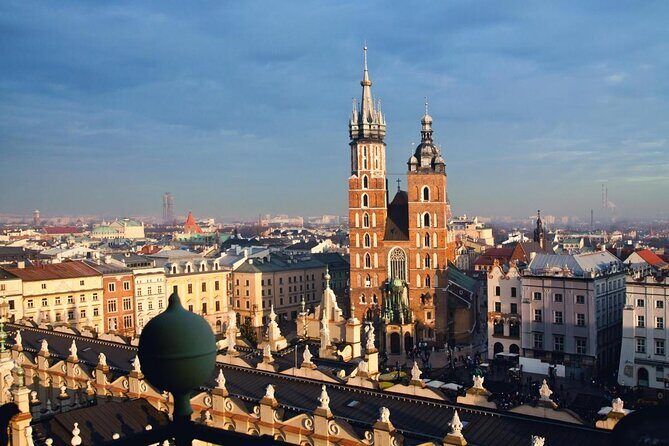
- Big-name Gdansk landmarks in one loop, from Neptune’s Fountain to St. Mary’s Church
- Solidarity-focused stops that connect the city’s WWII story to the shipyard era
- Extra time for the St. Bridget’s Church amber altar, with admission included
- A small-group cap of 30, so you usually don’t feel like part of a herd
Why a buggy beats “just walking” in Gdansk
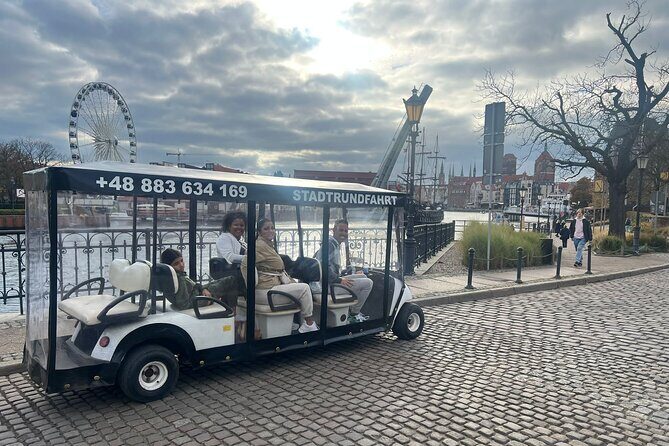
Gdansk can feel like a postcard you keep turning over. You get gorgeous facades, churches, gates, and river views close together—but also enough cobblestones to drain your energy fast. The golf cart format is built for this city. Instead of committing to mile after mile, you spend your energy on the moments that deserve it: the photo points, the architecture, and the stories your guide is telling in real time.
The second big win is how the route mixes Old Town icons with the newer history of the shipyard and political change. In one outing, you get both the classic “look at this building” Gdansk and the “this is why it matters” Gdansk.
Other golf cart and buggy tours in Gdansk


Price and what $51.97 really buys you
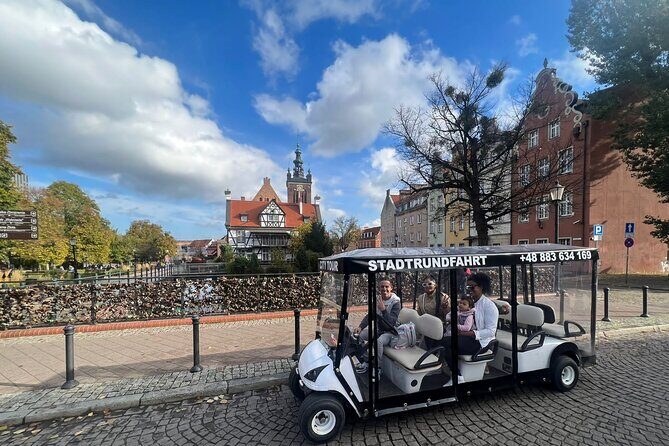
At $51.97 per person, you’re paying for three things at once: a live English guide, an electric buggy ride, and covered costs (the tour lists all fees and taxes). On a two-hour route, that’s the practical part: you’re buying time and context.
You’ll also get a bottled drink included (water, coffee, or beer). That sounds small, but it’s a real value add, especially if you’re doing this early in your trip. And for at least one major interior moment—the Amber Altar at St. Bridget’s Church—the tour includes admission.
In plain terms: if you want to get your bearings quickly and you don’t want to spend most of your limited sightseeing hours walking between far-flung stops, this price starts to make sense fast.
Pickup, timing, and how the day stays controlled
This tour starts at Neptune’s Fountain (Długi Targ area). If you choose pickup, it’s within a 2 km radius of Neptune’s Fountain, and the tour notes that pickup is not offered at ports. You should plan to be at your pickup point about 10 minutes before the scheduled start time.
Expect a smooth but busy pace: the tour is listed as about 2 to 2 hours 15 minutes, and most stops are quick—often a couple minutes—except for a longer moment at St. Bridget’s Church. Also note there can be slight delays tied to road traffic.
One more seasonal heads-up from the experience: a rider mentioned that in autumn it can get chilly in the buggy. If you’re traveling in cooler months, bring a light layer.
The Old Town circuit: Neptune’s Fountain to St. Mary’s Church
Here’s what you’ll see as the tour “sets the table” for Gdansk, starting in the historic center.
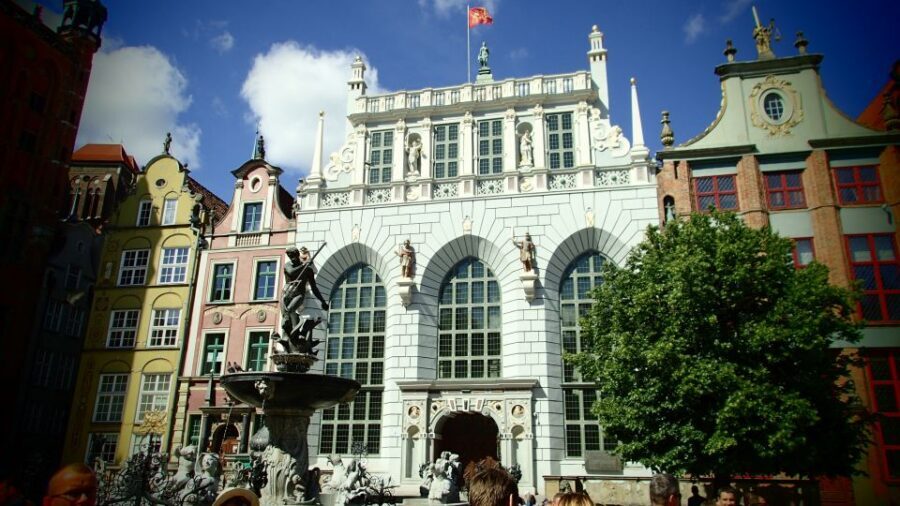
Stop 1: Neptune’s Fountain (Fontanna Neptuna)
This is the postcard symbol and the photo magnet. People line up here daily, so the short time works as a warm-up and a compass point for where everything is.
Stop 2: Main Town Hall – Museum of Gdansk
You’ll get a look at the 14th-century building that was reconstructed after WWII and now connects to the museum. Even without a long museum stop, it frames how much of the city was rebuilt.
Stop 3: Muzeum Gdańska / Arthur’s Court (merchant meeting place / stock exchange history)
Arthur’s Court is one of those places where the building’s past (merchants, then exchange) helps you understand Gdansk’s old economic role.
Stop 4: Dlugi Targ Square (Long Market Square)
This is the main square vibe: ideal for orientation. The stop is short, so use it for photos and street-level observations.
Stop 5: Green Gate (Brama Zielona)
A Renaissance gate with royal residence history, later tied into the museum world. The quick stop is enough to appreciate the style and the scale.
Stop 6: Gdansk Shakespeare Theatre
You’re shown a distinctive detail: it’s described as the only theatre in the world with a folding roof. It’s a good “wait, that’s cool” moment mid-route.
Stop 7: Katownia (Old Prison Tower)
The tower-and-torture-chamber area adds a darker note—Gdansk wasn’t only trade and art.
Stop 8: Langgasser Tor (Golden Gate)
Another gateway with royal entry history into Długa Street. Gates are great on a buggy because you catch them from multiple angles without backtracking.
Stop 9: Highland Gate
This gatehouse complex is also tied to the Royal Road story and acts as a tourist information point today.
Stop 10: Great Armoury (Wielka Zbrojownia)
A Dutch Mannerism-style building that signals Gdansk’s major institutional power. Even when the stop is only a couple minutes, you’ll feel why the guide includes it.
Stop 11: Drzewo Millennium (Millennium Tree)
A modern monument in polished stainless steel marking the city’s 1000-year anniversary. It’s brief but helps the tour move beyond “medieval only.”
Stop 12: Jan III Sobieski Monument
An equestrian statue with the note that it was built in Lviv then transferred to Gdansk. This is one of those details that makes the city feel connected to broader regional history.
Stop 13: Gdansk Główny Railway Station
Opened in 1900, it’s included for its historical weight. You’ll likely appreciate it more if you like transport history or how cities evolve.
Stops 14–16: Churches and civic survivors
- Stop 14: St. Joseph’s Church (15th-century, rebuilt after WWII)
- Stop 15: Church of St. Elizabeth (site with hospital/poor and sick history; reconstruction 1947–1949)
- Stop 16: Ratusz Starego Miasta (Old Town Hall) (noted as one of the few historic buildings that survived war damage)
These are quick looks, but the guide’s job here is to connect architecture to what happened in the 20th century.
Stop 17: The Great Mill
A former major Medieval industrial plant, rebuilt after WWII, and now home to the amber museum. If you care about how Gdansk produced wealth, this is a smart pivot.
Stop 18: St. Catherine’s Church
A church with a long timeline: Protestant period after 1545, then back to Catholic after 1945. That religious shift is the kind of context you usually only get from a guide.
Stop 19: St. Bridget’s Church + Amber Altar (15 minutes, admission included)
This is the tour’s big interior moment. The amber altar is described as massive—twice the size of the legendary Amber Room and more than three times as high—and it’s included. If you’re making one “must-see inside” choice, this is the one the tour is clearly built around.
Stops 20–22: WWII-era story and Solidarity Square
- Stop 20: Museum of the Polish Post Office and the monument to defenders tied to the defense in 1939
- Stop 21: European Solidarity Centre (Solidarity Museum)
- Stop 22: Three Crosses Monument (steel monument tied to the shipyard worker victims of December 1970, with anchors and a very large scale)
The transition here is important: the tour moves from historic town texture into modern political identity.
Solidarity Square to the shipyard: the modern history stretch
After the classic center, the route shifts toward Gdansk’s 20th-century turning points. This part is where the tour earns its “introduction to the city” label.
Stop 23: Sala BHP
This is tied to the August strike and agreements in 1980 tied to Lech Wałęsa, plus the birth of Solidarity. Even without going deep inside, the guide’s framing is likely the point.
Stop 24: Gdansk Shipyard (Stocznia Gdańska / former Lenin Shipyard)
You’ll get a focused look at the shipyard area that gained fame when Solidarity was founded there in September 1980. It’s a key emotional anchor for many visitors.
Stop 25: Museum of the Second World War
Opened in 2017 and dedicated to WWII. The stop is brief, so think of it as setting your next step if you want a longer museum visit later.
Stop 26: Baltic Symphony Hall (former municipal power plant)
Included for its building story: the tour notes it’s the rebuilt and extended power plant. You can understand why a modern concert hall belongs on a history route.
Stops 27–31: Gothic churches and a “survive the war” theme
- Stop 27: St. John’s Church (14th-century Gothic, cultural centre)
- Stop 28: Crane (the large medieval port crane on the Motława River)
- Stop 29: St. Mary’s Church (big Gothic brick church; one of the most famous landmarks)
- Stop 30: Royal Chapel (Kaplica Krolewska) (17th-century Baroque with a central dome, richly decorated facade)
- Stop 31: St. Nicholas Church (Dominican church, history from the 12th century; described as one of the unique churches that survived WWII)
These stops are photo-friendly, but they also create a pattern: Gdansk’s character survives through rebuilding, reinvention, and the way communities keep using these spaces.
Other guided tours in Gdansk



Finishing touches: Market Hall and the feel-good city core

You end with more civic and everyday life landmarks.
Stop 32: Market Hall (Hala Targowa 1896)
This is the oldest shopping centre in Gdansk (according to the tour info). It’s a practical final stop because it helps you remember that this is still a living city, not only a museum.
Then it all circles back to Neptune’s Fountain as the endpoint. Ending near the start area is handy if you’re going to grab lunch or continue exploring on your own.
Guides: what you can look for, and why it matters
This tour is strongest when the guide connects the dots between architecture and history. The feedback highlights the role of the guide a lot.
Some guides you might encounter include Michael, Matchek, Maciej, Noris, and Mariana, all mentioned in the experience feedback. The common theme is storytelling: not just dates, but how the city changed through Nazi and Soviet eras and what those changes meant to local life.
One practical note: one review mentioned a guide with a Cuban accent and fast speech. If you’re watching for clarity, it’s still worth booking, but you may want to be ready to ask questions if you need slower pacing.
Who this tour fits best
This is a strong match if you:
- Have limited time and want a high-coverage introduction to Gdansk
- Want to see both Old Town highlights and the Solidarity/shipyard storyline
- Prefer an electric ride over long walking
- Like guided context more than self-guided wandering
It may be less ideal if you:
- Want long museum time at multiple indoor stops (many are intentionally short)
- Expect a lot of flexibility to linger inside churches
- Are very sensitive to temperature in the buggy (a light layer helps)
Should you book the Gdansk electric buggy tour?
If you’re arriving in Gdansk and want to build a mental map fast, I think this is a very smart first move. The combination of electric buggy pacing, live English guidance, the included drink, and the amber altar admission makes it good value for a short trip.
I’d book it if you want an efficient loop that hits Neptune’s Fountain, the classic gates and churches, and then lands you in the Solidarity and shipyard area without you needing to figure out the route on your own.
Skip it only if you plan to spend most of your day in museums and insist on long indoor sessions at multiple stops. In that case, you’ll likely want to pair Gdansk’s highlights with a slower, museum-first day later.
FAQ
How long is the Gdansk buggy city sightseeing tour?
The tour is listed at about 2 hours to 2 hours 15 minutes.
Is pickup offered, or do I need to meet at Neptune’s Fountain?
Pickup is offered within a 2 km radius from Neptune’s Fountain. You can also meet at Neptune’s Fountain itself. Pickup is not offered at ports.
What language is the tour guide?
The tour is offered with a live guide in English.
What’s included in the price?
The price includes a live guide, all fees and taxes, and a drink for each tourist (water, coffee, or beer). The amber altar admission at St. Bridget’s Church is listed as included.
Does the itinerary change during specific dates?
The tour notes that from July 27 to August 25, 2025, there are some restrictions due to Saint Dominic’s Fair and the itinerary will undergo some changes, while keeping normal schedule and length.
Is the tour dependent on weather?
Yes. The tour requires good weather, and if it’s canceled due to poor weather, you’ll be offered a different date or a full refund.